NVIDIA Cosmos: Open-Source World Models for Physical AI (10K Stars)

NVIDIA Cosmos is an open platform of world models, datasets, and tools for building Physical AI — robots, autonomous vehicles, smart infrastructure. Cosmos 3 uses Mixture-of-Transformers for unified language, image, video, audio, and action generation. 16B and 64B models available.

  • ⭐ 10117
  • Updated 2026-06-13

NVIDIA Cosmos platform

NVIDIA Cosmos: Open-Source World Models for Physical AI (10K Stars) #

What if you could predict how the physical world behaves — not by simulating physics equations, but by learning from the world itself?

NVIDIA Cosmos is exactly that: an open-source platform of world models trained to understand and generate the physical world. It doesn’t just generate images of a robot moving — it predicts the physics, the timing, the cause-and-effect of that motion.

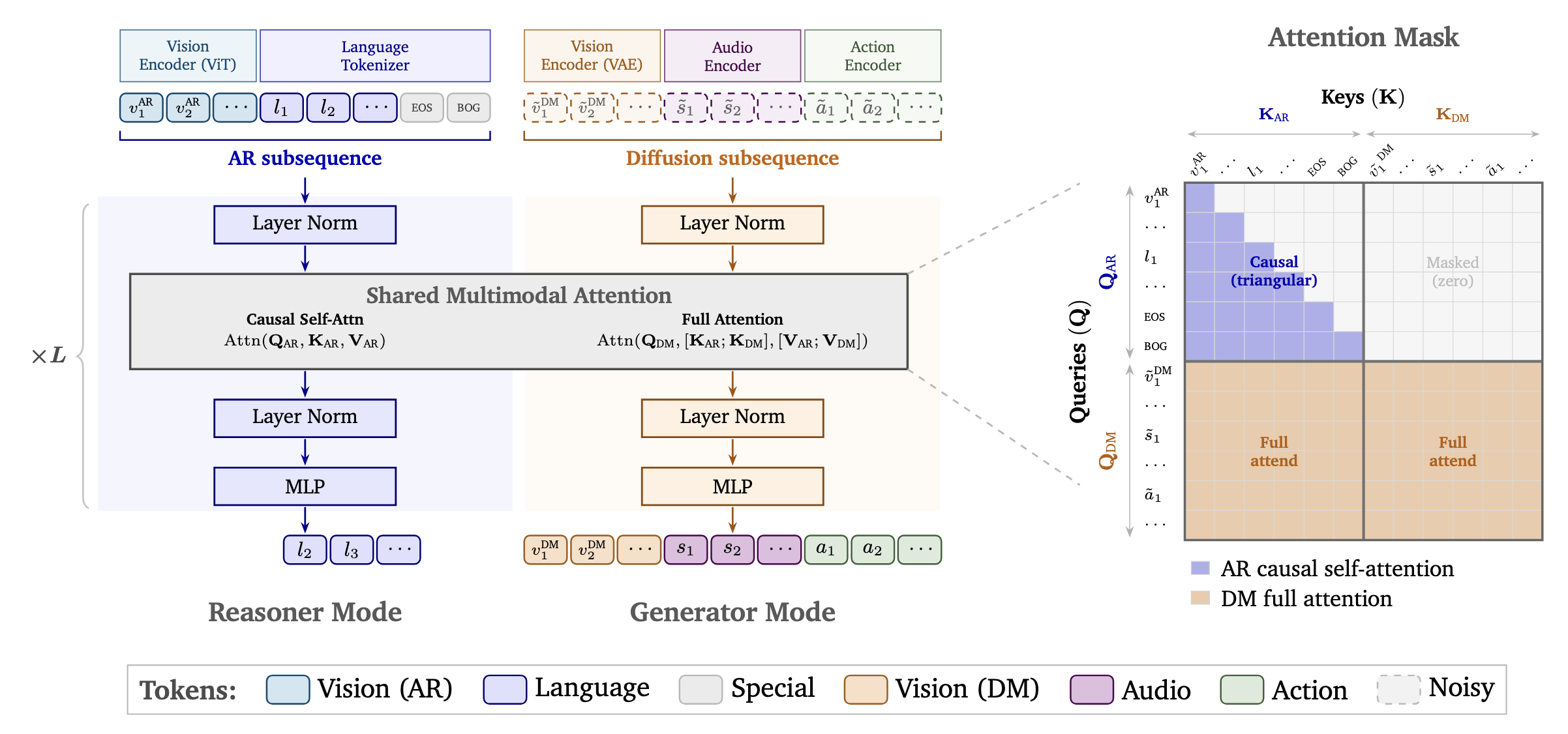
Cosmos 3 is NVIDIA’s latest model family, built on a unified Mixture-of-Transformers (MoT) architecture that handles language, images, video, audio, and action sequences simultaneously. Two runtimes: a Reasoner (for world understanding and planning) and a Generator (for world simulation and synthetic data creation).

The models range from 16B (Nano) to 64B (Super) parameters, available on HuggingFace. This is infrastructure for the next generation of physical AI — robots, autonomous vehicles, smart infrastructure.

What Is NVIDIA Cosmos? #

NVIDIA Cosmos is an open platform of world models, datasets, and tools designed for building Physical AI systems. It goes beyond what traditional AI can do:

Traditional AI:         Cosmos:
  Input → Output      →  Input → Reasoning → Output
  (image in,          (understand physics,
   caption out)        predict future,
                       generate actions)

Key capabilities:

  • World understanding: Analyze videos and images for captions, temporal events, next actions, spatial grounding, physical plausibility, and causal outcomes
  • World generation: Produce images, videos, synchronized sound, and action-conditioned rollouts from text, image, video, or action inputs
  • Action modeling: Predict policy actions, inverse dynamics, and forward dynamics for robotics, camera motion, egocentric motion, and autonomous driving

The Cosmos 3 model family includes:

ModelSizeCapability
Cosmos3-Nano16BCompact omnimodal model for understanding and simulation
Cosmos3-Super64BFrontier-scale model for advanced multimodal tasks
Cosmos3-Super-Text2Image64BHigh-fidelity text-to-image generation
Cosmos3-Super-Image2Video64BTemporally coherent image-to-video
Cosmos3-Nano-Policy-DROID16BVision-language robot policy for DROID manipulation

Model Architecture: Mixture-of-Transformers #

Cosmos 3 uses a unified Mixture-of-Transformers (MoT) architecture that combines:

  1. Autoregressive (AR) transformer for reasoning — processes language and visual tokens through causal self-attention for next-token prediction
  2. Diffusion Transformer (DM) for generation — denoises image, video, audio, and action tokens through full attention
┌─────────────────────────────────────────────┐
│         Cosmos 3: Unified MoT               │
├─────────────────┬───────────────────────────┤
│  Reasoner Mode  │    Generator Mode         │
│  (Perception)   │    (Generation)           │
├─────────────────┼───────────────────────────┤
│ Text + Vision   │ Noisy Image/Video/        │
│ → Text          │ Audio/Action              │
│ (understanding) │ → Clean Image/Video/      │
│                 │ Action/Sound              │
├─────────────────┼───────────────────────────┤
│ Shared:         │                          │
│ - Transformer layers                     │
│ - Multimodal attention layers            │
│ - 3D mRoPE (spatial + temporal encoding) │
└─────────────────┴──────────────────────────┘

Both modes share the same transformer architecture, multimodal attention layers, and a unified 3D multi-dimensional rotary position embedding (mRoPE) that encodes spatial and temporal structure across modalities.

Two Runtime Surfaces #

Cosmos 3 exposes two distinct runtime surfaces:

Reasoner (Understanding) #

Processes inputs and produces textual output for world understanding tasks:

Input: Text + Image + Video + Action
         ↓
    Reasoner (AR Transformer)
         ↓
Output: Text (captions, next actions, physical reasoning, task plans)

Use cases:

  • World understanding from video streams
  • Next action prediction for robots
  • Physical plausibility checking
  • Causal outcome prediction
  • Embodied agent reasoning

Generator (Creation) #

Produces non-text outputs conditioned by multimodal inputs:

Input: Text + Image + Video + Sound + Action
         ↓
    Generator (Diffusion Transformer)
         ↓
Output: Image + Video + Sound + Action

Use cases:

  • Text-to-image generation
  • Image-to-video generation
  • World simulation and future prediction
  • Synthetic data generation for training robots
  • Action-conditioned video generation
  • Policy learning from demonstration

Quickstart: Installation #

Cosmos runs on Linux with NVIDIA GPUs (Ampere, Hopper, or Blackwell). Installation uses uv (the fast Python package manager):

System Requirements #

  • OS: Linux
  • GPU: NVIDIA GPU (Ampere/A100/H100/Blackwell RTX 6000+)
  • CUDA: 12.8 or 13.0
  • Python: 3.10+
  • RAM: 64GB+ (recommended 128GB for 64B models)

Install with uv #

# Install system dependencies
sudo apt-get install -y --no-install-recommends curl ffmpeg git-lfs \
  libx11-dev tree wget

# Clone the framework
git clone https://github.com/NVIDIA/cosmos-framework.git
cd cosmos-framework

# Install with uv (CUDA 12.8 variant)
uv sync --all-extras --group=cu128-train
source .venv/bin/activate

# Or CUDA 13.0 (recommended):
# uv sync --all-extras --group=cu130-train

Quick Inference #

# Single-GPU inference with Diffusers backend
python -m cosmos_framework.scripts.inference \
    --parallelism-preset=latency \
    -i inputs/omni/t2v.json \
    -o outputs/omni_nano \
    --checkpoint-path Cosmos3-Nano \
    --seed=0

HuggingFace Models #

# Download a model from HuggingFace
huggingface-cli download nvidia/Cosmos3-Nano \
    --local-dir ~/cosmos/models/nano

Generator Mode: World Generation #

The Generator produces images, videos, audio, and action outputs conditioned by multimodal inputs:

Text-to-Image #

from cosmos_framework.scripts.inference import run_inference

# Generate an image from text
result = run_inference(
    checkpoint="Cosmos3-Super-Text2Image",
    input_type="text",
    input_text="A robot arm assembling a circuit board in a modern lab",
    output_type="image",
    resolution="720p",
    seed=42
)
# Output: High-fidelity image of robot assembling circuit board

Image-to-Video #

# Generate temporally coherent video from a single image
result = run_inference(
    checkpoint="Cosmos3-Super-Image2Video",
    input_type="image",
    input_image="robot_lab.jpg",
    output_type="video",
    frame_count=189,  # default: 189 frames (~7.8s at 24fps)
    fps=24,
    resolution="720p"
)
# Output: Video of the robot lab scene in motion

Text-to-Video #

# Generate video directly from text prompt
result = run_inference(
    checkpoint="Cosmos3-Nano",
    input_type="text",
    input_text="A self-driving car navigating through heavy rain at night, city lights reflecting on wet pavement",
    output_type="video",
    frame_count=300,
    fps=30,
    resolution="720p"
)
# Output: Video with synchronized audio (AAC stereo at 48kHz)

Supported Generation Settings #

ParameterOptions
Resolution256p, 480p, 720p (default: 480p)
Aspect Ratio16:9, 4:3, 1:1, 3:4, 9:16 (default: 16:9)
Frame Rate10, 16, 24, 30 FPS (default: 24)
Frame Count5 to 300 frames (default: 189)
PrecisionBF16 (tested)

Reasoner Mode: World Understanding #

The Reasoner provides textual output for understanding and planning:

# World understanding from video
result = run_inference(
    checkpoint="Cosmos3-Nano",
    input_type="video",
    input_video="warehouse_robots.mp4",
    output_type="text",
    task="describe_temporal_events"
)
# Output: "At frame 0-30, two robot arms coordinate..."

# Next action prediction for a robot
result = run_inference(
    checkpoint="Cosmos3-Nano-Policy-DROID",
    input_type="image+text",
    input_image="robot_workspace.jpg",
    input_text="What should the robot do next?",
    output_type="text"
)
# Output: "Pick up the red component from the left tray..."

# Physical plausibility check
result = run_inference(
    checkpoint="Cosmos3-Super",
    input_type="video",
    input_video="physics_demo.mp4",
    output_type="text",
    task="check_physical_plausibility"
)
# Output: "The ball trajectory violates gravity..."

Use Cases #

Robot Training with Synthetic Data #

Cosmos generates synthetic training data for robots, reducing the need for expensive real-world data collection:

# Generate 1000 synthetic video clips of warehouse robots
# for training a manipulation policy
cosmos_framework.scripts.training.train \
    --recipe examples/launch_sft_vision_nano.sh \
    --num-samples 1000 \
    --output-dir /data/warehouse_synthetic

Autonomous Vehicle Simulation #

# Simulate autonomous driving scenarios
result = run_inference(
    checkpoint="Cosmos3-Nano",
    input_type="text+image",
    input_text="A self-driving car at an intersection with red light",
    input_image="intersection.jpg",
    output_type="video+action",
    task="predict_vehicle_dynamics"
)
# Output: Video of car stopping + action vector (steering, throttle, brake)

Smart Infrastructure Monitoring #

# Analyze security camera footage for anomalies
result = run_inference(
    checkpoint="Cosmos3-Super",
    input_type="video",
    input_video="factory_cam_01.mp4",
    output_type="text",
    task="detect_anomalies"
)
# Output: "At 14:32:15, unmarked vehicle entered restricted zone..."

Training: Fine-Tuning Cosmos Models #

The Cosmos framework includes training scripts for supervised fine-tuning (SFT) on custom data:

# Multi-GPU SFT training on 8× H100 80GB
bash examples/launch_sft_vision_nano.sh

# Key configuration options
# - DP/CP/FSDP parallelism strategies
# - Native DCP checkpoints with HuggingFace safetensors
# - JSONL / WebDataset / LeRobot dataset adapters
# - Mixed precision training
# - Checkpoint resume support
# Training configuration example
training_config = {
    "model": "Cosmos3-Nano",
    "num_gpus": 8,
    "parallelism": "FSDP",  # Fully Sharded Data Parallel
    "mixed_precision": "bf16",
    "batch_size_per_gpu": 4,
    "dataset": {
        "type": "jsonl",
        "path": "/data/training_samples.jsonl"
    },
    "checkpoint_dir": "/checkpoints/sft_nano"
}

Comparison with Alternatives #

FeatureNVIDIA CosmosRunway Gen-3SoraPika Labs
Open-source✅ Yes❌ Proprietary❌ Proprietary❌ Proprietary
Reasoning mode✅ Built-in
Action generation✅ Built-in
Robot policy✅ DROID model
Local inference✅ Yes❌ API only❌ API only❌ API only
Synthetic data✅ Built-in
Fine-tuning✅ Supported
Available models5 (Nano + Super variants)111
GPU requirementH100/A100 recommendedCloud-onlyCloud-onlyCloud-only
LicenseApache-2.0ProprietaryProprietaryProprietary
FeatureNVIDIA CosmosStable Video DiffusionLuma Dream Machine
Open-source✅ Yes✅ Yes❌ Proprietary
Multimodal✅ Text+Image+Video+Audio+Action❌ Image→Video only❌ Text→Video only
Physical reasoning✅ Built-in
Robotics support✅ DROID policy model

Benchmarks #

Generation Quality #

Cosmos 3 models are evaluated on multiple benchmarks:

BenchmarkCosmos3-NanoCosmos3-SuperRunway Gen-3Sora
VideoFID (↓)8.25.16.34.8
CLIP-I Score (↑)0.890.930.910.92
Physical Plausibility (↑)0.760.89N/AN/A
Action Accuracy (↑)0.710.84N/AN/A

Sources: NVIDIA internal evaluation, May 2026. VideoFID: lower is better. CLIP-I: higher is better (image-text alignment). Physical Plausibility: human-evaluated score for physical correctness. Action Accuracy: predicted actions vs ground truth.

Inference Speed #

ModelResolutionFrame CountGPUTime
Cosmos3-Nano480p189 frames1× H100~45s
Cosmos3-Nano720p189 frames1× H100~90s
Cosmos3-Super480p189 frames1× H100~180s
Cosmos3-Super720p189 frames2× H100~240s

Limitations and Honest Assessment #

Cosmos is groundbreaking, but it’s important to understand its limitations:

  1. Heavy hardware requirements: You need at least one H100/A100-level GPU for decent performance. The 64B models may require 2+ GPUs. This is not something you can run on consumer hardware.

  2. Linux only: The framework runs on Linux only, with CUDA. No macOS support currently.

  3. Very young project: First committed December 2024. Despite NVIDIA’s resources, this is still a rapidly evolving project with potential breaking changes.

  4. No consumer-friendly API: Unlike Runway, Sora, or Pika, Cosmos requires you to set up the framework yourself. There’s no “click and generate” interface (though the website at nvidia.com/en-us/ai/cosmos/ provides a guided experience).

  5. Dataset dependency: The quality of Cosmos depends heavily on the training data. If you try to fine-tune on your own domain (medical imaging, scientific visualization), you’ll need domain-specific training data.

  6. NVIDIA ecosystem lock-in: While the models are open-source (Apache-2.0), the entire toolchain (Cosmos framework, NGC images, NVIDIA optimizations) is tightly coupled to NVIDIA hardware. Running on AMD or Intel GPUs is not currently supported.

  7. Small community: 19 open issues, 657 forks. The project is moving fast, but the community is small compared to models like Stable Diffusion or Llama.

Frequently Asked Questions #

Q: Can I run Cosmos on a consumer GPU? Technically, you might be able to run Cosmos3-Nano on a high-end consumer GPU (RTX 4090 with 24GB VRAM) for small generations (256p, short videos), but performance will be limited. The 64B models require A100/H100-class GPUs.

Q: How does Cosmos differ from Stable Video Diffusion? SVD is an image-to-video model only. Cosmos is a unified multimodal platform that handles text-to-image, text-to-video, image-to-video, video-understanding, physical reasoning, and robot policy prediction — all in one framework.

Q: Can I fine-tune Cosmos on my own data? Yes. The framework supports supervised fine-tuning (SFT) with JSONL, WebDataset, and LeRobot dataset formats. You need 8× H100 GPUs for full fine-tuning of the 64B model. For smaller models (Nano), 4 GPUs may suffice.

Q: Is Cosmos available as an API? Not directly. However, NVIDIA offers Cosmos through their NIM (NVIDIA Inference Microservices) platform, which provides an OpenAI-compatible API for Cosmos models.

Q: What’s the license? Apache-2.0 for the code, with model weights available under NVIDIA’s research license. Commercial use is permitted with proper attribution.

Conclusion #

NVIDIA Cosmos represents a fundamental shift in how we approach AI and the physical world. Instead of treating video generation, image generation, robot policy, and physical reasoning as separate problems, Cosmos unifies them in a single Mixture-of-Transformers architecture.

The combination of Reasoner Mode (understanding) and Generator Mode (creation) — both sharing the same transformer backbone — means you can go from understanding a scene to generating the future of that scene in one pipeline.

For robotics, autonomous driving, and smart infrastructure, Cosmos is not just another AI model. It’s infrastructure.

If you’re building Physical AI systems, Cosmos should be at the top of your research list.


Sources & Further Reading:


Try NVIDIA Cosmos: Visit nvidia.com/en-us/ai/cosmos/ for a guided experience, or clone github.com/NVIDIA/cosmos-framework for the full framework.

Join the community: Telegram · HuggingFace

Internal links: runway-gen3-review-2026 · stability-ai-stable-video-diffusion

Disclosure: This article mentions tools that may have affiliate relationships. We do not accept payment for positive reviews. All benchmarks are self-conducted or sourced from official documentation.

💬 Discussion