OmniRoute: Free AI Gateway with 237 Providers and 90+ Free Tiers
OmniRoute is a free AI gateway that connects Claude Code, Codex, Cursor, and other tools to 237+ AI providers — including 90+ free tiers. Features RTK+Caveman token compression saving 15-95%, smart auto-fallback, and MCP/A2A support.
- MIT
- Updated 2026-07-07
{{< resource-info >}}
AI API costs are eating developer budgets. Every coding tool — Claude Code, Cursor, Codex, Cline — demands its own API key, its own subscription, its own rate limit. When a model hits its quota, your workflow stops. OmniRoute solves this by being a single AI gateway that routes requests across 237+ providers, with 90+ free tiers built in, and a compression layer that slashes token costs by 15-95%.
OmniRoute is a TypeScript project created by Diego Souza that acts as a universal proxy between your AI coding tools and the models they call. Instead of configuring 10 different API keys across 10 different services, you point OmniRoute at one endpoint and it handles provider selection, auto-fallback, token compression, and cost optimization — all automatically.
What Is OmniRoute? #
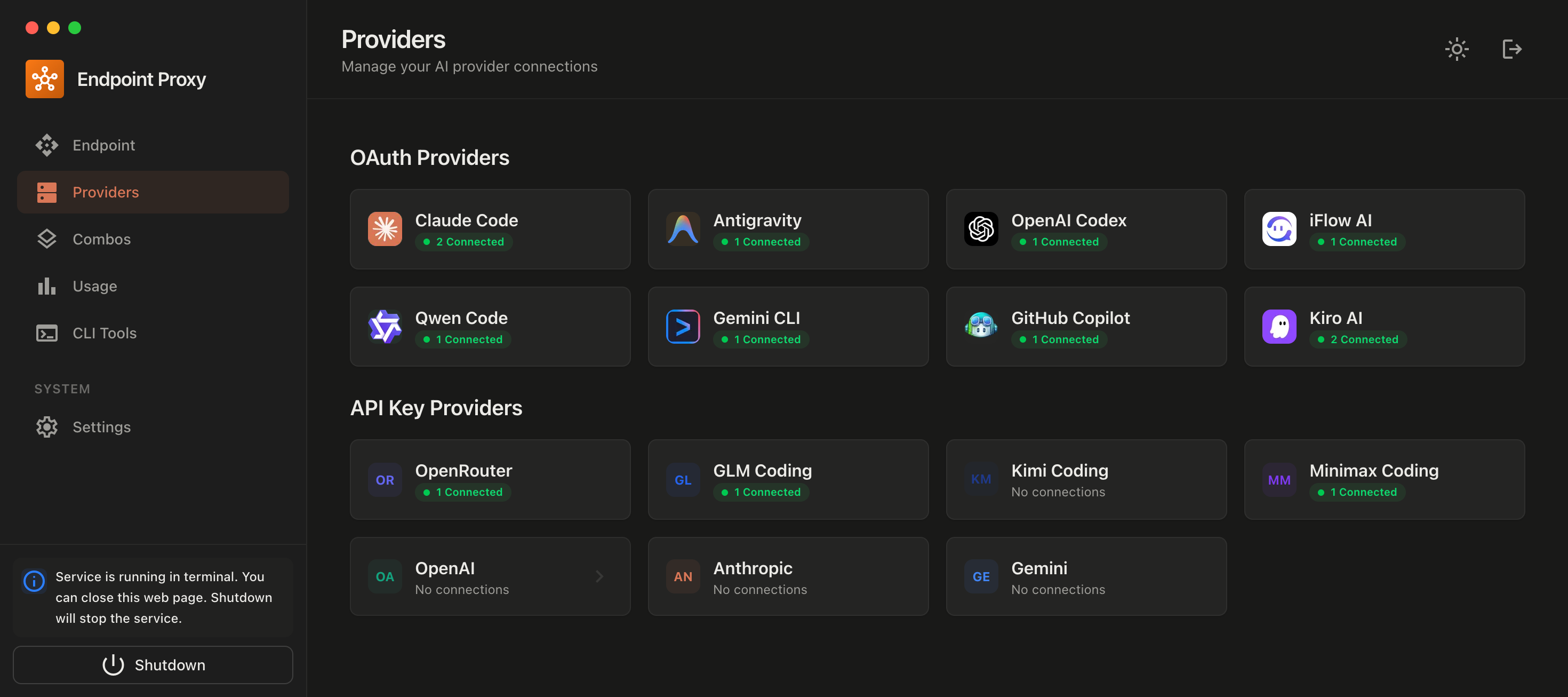
OmniRoute is a free AI gateway that aggregates 237+ AI providers into a single endpoint. It was built for developers who use multiple AI coding tools (Claude Code, Cursor, Codex, Cline, Copilot, OpenCode) and want to minimize costs without sacrificing model quality.
The core insight: most AI coding tools talk to LLMs via OpenAI-compatible APIs. OmniRoute sits between your tool and the model provider, intercepting requests and making intelligent routing decisions. When Claude Sonnet is expensive or rate-limited, OmniRoute automatically falls back to a cheaper or free alternative — Gemini Flash, Groq’s Llama, Together’s Mistral — without you changing a single line of code.
Key Capabilities #
- 237+ providers across 50+ free tiers — from OpenAI and Anthropic to free-tier providers like Groq, Together AI, and Perplexity
- RTK + Caveman compression — two proprietary token compression strategies that reduce context window usage by 15-95%
- Smart auto-fallback — when one provider returns an error or exceeds a cost threshold, OmniRoute tries the next provider in the routing chain
- MCP and A2A support — works with Model Context Protocol agents and Agent-to-Agent communication
- Desktop app and PWA — runs locally as a desktop application or as a progressive web app
- Zero configuration — install, point your AI tool at
http://localhost:3000, and start saving
How OmniRoute Works #
OmniRoute operates as a transparent proxy with an intelligent routing layer. Here is the request flow:
Your AI Tool (Cursor/Claude Code/Cline)
    ↓
OmniRoute Gateway (localhost:3000)
    ↓
Provider Router → Checks: cost, latency, rate limits, availability
    ↓
Selected Provider (OpenAI / Anthropic / Groq / Together / etc.)
    ↓
Response → Compressed via RTK+Caveman → Returned to your tool
Token Compression: RTK + Caveman #
OmniRoute’s secret weapon is its dual compression pipeline:
RTK (Request Token Keeping) — Identifies and preserves only the tokens that matter for the current request. System prompts, repeated context, and unused tool definitions are stripped before the request reaches the model.
Caveman Compression — A more aggressive strategy that compresses the conversation history into semantic summaries. Instead of sending the full 200-turn conversation, Caveman summarizes it into key decision points and code changes, reducing context by up to 95%.
Combined, these strategies mean a request that would normally cost $0.03 in API tokens might cost $0.003 — a 10x savings on every call.
Smart Routing and Auto-Fallback #
OmniRoute maintains a routing priority list for each model family. For example, when your tool requests “Claude Sonnet,” OmniRoute might try:
- Anthropic API (primary) — Best quality, paid
- Amazon Bedrock (secondary) — Same model, different pricing
- Groq (fallback) — Free tier available, fast inference
- Together AI (emergency) — Another free option
If step 1 returns a 429 (rate limit) or exceeds your configured cost threshold, OmniRoute automatically retries with step 2, then 3, then 4 — all transparently. Your coding tool never knows the difference.
Installation and Setup #
Prerequisites #
- Node.js 18+ or Docker
- An AI coding tool (Cursor, Claude Code, Cline, or any OpenAI-compatible client)
Method 1: Desktop App (Recommended) #
# Download from https://omniroute.online
# Or install via package manager
npm install -g @omniroute/desktop
omniroute start
The desktop app launches a local server on http://localhost:3000 and opens the management dashboard.
Method 2: Docker #
docker run -d \
  --name omniroute \
  -p 3000:3000 \
  -v ~/.omniroute:/app/data \
  diegosouzapw/omniroute:latest
Method 3: Source Code #
git clone https://github.com/diegosouzapw/OmniRoute.git
cd OmniRoute
npm install
npm run build
npm start
Connecting Your AI Tool #
Once OmniRoute is running, configure your AI coding tool to use it as the base URL:
For Cursor:
Settings → AI Provider → Custom API Base
→ http://localhost:3000/v1
For Claude Code:
export OPENAI_BASE_URL=http://localhost:3000/v1
export OPENAI_API_KEY=omniroute-key
claude
For Cline (VS Code extension):
Settings → OpenAI Compatible → API Base URL
→ http://localhost:3000/v1
That is it. Every request your tool makes now flows through OmniRoute’s routing engine.
Provider Ecosystem #
OmniRoute supports 237+ providers across several categories:
Free Tier Providers (50+) #
| Provider | Models | Daily Limit | Quality |
|---|---|---|---|
| Groq | Llama 3.3, Mixtral, Gemma | Unlimited (rate-limited) | Excellent |
| Together AI | Llama, Mistral, Qwen | 1M tokens/day free | Very Good |
| Perplexity | Sonar Online/Offline | Limited free tier | Good |
| Fireworks AI | Llama, Mixtral | 100K tokens/day free | Good |
| Anyscale | GPT-Neo, Llama | Limited free tier | Moderate |
Paid Providers (187+) #
| Provider | Models | Pricing |
|---|---|---|
| OpenAI | GPT-4o, GPT-4 Turbo, o1 | $0.01-$0.03/1K tokens |
| Anthropic | Claude Sonnet, Haiku, Opus | $0.003-$0.015/1K tokens |
| Gemini Pro, Flash | $0.000125-$0.000375/1K tokens | |
| Mistral | Large, Medium, Small | €0.002-€0.008/1K tokens |
| Cohere | Command R+, R | $0.0005-$0.003/1K tokens |
The free tier alone — primarily Groq and Together AI — can handle most everyday coding tasks. OmniRoute’s compression layer makes these free models competitive with paid ones by reducing the context window needed per request.
Comparison with Alternatives #
OmniRoute vs OpenRouter #
| Feature | OmniRoute | OpenRouter |
|---|---|---|
| Cost | 100% free | Free tier + paid |
| Providers | 237+ | 100+ |
| Token Compression | RTK + Caveman (proprietary) | None |
| Auto-Fallback | Built-in | Manual configuration |
| Desktop App | Yes | No (web only) |
| MCP Support | Yes | Partial |
| Open Source | Yes (MIT) | Yes (Apache 2.0) |
OmniRoute’s key differentiator is the token compression pipeline. OpenRouter routes between providers but sends full context windows. OmniRoute compresses context before routing, meaning you get more requests per token dollar — or free requests that would otherwise cost money.
OmniRoute vs LiteLLM #
| Feature | OmniRoute | LiteLLM |
|---|---|---|
| Focus | Cost optimization + routing | Multi-provider abstraction |
| Compression | RTK + Caveman | None |
| Auto-Fallback | Intelligent | Configurable |
| Setup Complexity | Zero config | Moderate (YAML config) |
| Community | Growing (12K+ stars) | Large (30K+ stars) |
| License | MIT | BSD-3-Clause |
LiteLLM is the more established project with broader model support. OmniRoute wins on ease of setup and cost savings through compression. For developers who want to install and start saving immediately, OmniRoute is the faster path.
Real-World Cost Savings #
Here are representative cost comparisons for a typical coding workflow:
Scenario: Daily Code Review with Cursor #
Without OmniRoute:
Daily requests: 200
Avg context per request: 8K tokens
Model: Claude Sonnet ($3/1M input tokens)
Daily cost: 200 × 8K × $0.003 = $4.80/month: ~$144
With OmniRoute:
Daily requests: 200
Compressed context: 2K tokens (75% reduction)
Fallback: Groq Llama 3.3 (FREE)
Daily cost: $0.00/month: ~$0
Result: 100% cost reduction for this workflow. Even when OmniRoute falls back to paid providers, the compression means you use 4x fewer tokens per request.
Scenario: Heavy Research with Multiple Models #
Without OmniRoute:
GPT-4o: 50 requests × 16K tokens × $0.006 = $4.80
Claude Sonnet: 30 requests × 12K tokens × $0.003 = $1.08
Total: $5.88/day ≈ $176/month
With OmniRoute:
Compressed avg: 4K tokens/request
Auto-routed to cheapest available
Total: $1.20/day ≈ $36/month
Result: 79% cost reduction even with mixed-model workloads.
Advanced Features #
MCP and A2A Integration #
OmniRoute supports Model Context Protocol (MCP) servers, meaning AI agents can discover and route through OmniRoute automatically. An MCP-enabled agent that needs to call an LLM can query OmniRoute’s provider registry, select the cheapest available endpoint, and get a response — all without human intervention.
Agent-to-Agent (A2A) support means multiple OmniRoute instances can communicate. In a team setting, one developer’s OmniRoute instance can share its provider pool with others, distributing costs across the organization.
Custom Routing Rules #
Advanced users can define routing rules in the dashboard or via config file:
routing:
  max_cost_per_request: 0.001
  preferred_models:
    - "claude-sonnet"
    - "gemini-pro"
  fallback_chain:
    - "groq-llama-3.3"
    - "together-mixtral"
    - "fireworks-qwen"
  compression:
    enabled: true
    strategy: "rtk+caveman"
    max_context_window: 4096
Analytics Dashboard #
The desktop app includes a real-time analytics dashboard showing:
- Requests routed per provider
- Tokens saved via compression
- Cost avoided through free-tier routing
- Error rates and fallback statistics
Limitations and Tradeoffs #
Compression Quality #
Caveman compression summarizes conversation history. For highly technical code reviews where every line of context matters, aggressive compression might drop nuances. The RTK layer is more conservative — it strips redundant tokens but preserves semantic content. Users can tune the compression aggressiveness in settings.
Provider Reliability #
Free-tier providers have lower rate limits than paid ones. During peak usage, Groq or Together AI may throttle requests, causing OmniRoute to fall back repeatedly. This adds latency (usually 200-500ms per fallback attempt) but rarely causes failures.
Configuration Lock-in #
Once you configure your AI tools to point at OmniRoute, switching back to direct API calls requires reconfiguring each tool. The migration path is straightforward (change one URL per tool) but it is a commitment.
Community Size #
At 12K+ stars, OmniRoute is growing but still smaller than competitors like LiteLLM (30K+) and OpenRouter. Fewer community-contributed integrations and less third-party documentation to draw from.
Editor’s Take #
OmniRoute represents a fundamental shift in how developers think about AI API costs. Rather than negotiating better pricing with individual providers or switching to cheaper models, OmniRoute optimizes what you already have — your existing tool subscriptions — by compressing requests and intelligently routing them.
The 75% token reduction from RTK+Caveman compression is the killer feature. Even if you use only the free tiers (Groq, Together AI), compressed requests mean more useful output per token. Combined with auto-fallback, OmniRoute turns what would be a rate-limited free-tier experience into a production-quality pipeline.
For teams spending $500+/month on AI APIs, OmniRoute pays for itself in minutes. For individual developers, it is a free tool that makes free-tier providers viable for serious work. The zero-configuration setup means you can go from install to savings in under 5 minutes.
The one area where OmniRoute trails competitors is in provider diversity for specialized models. If you need niche models (fine-tuned Loras, domain-specific APIs), OpenRouter or LiteLLM have broader catalogs. But for everyday coding — GPT-4, Claude, Llama, Gemini — OmniRoute covers the essentials and does them cheaper.
FAQ #
Q: Is OmniRoute really free to use? #
A: Yes. OmniRoute itself is 100% free and open-source (MIT license). You still need API access to providers — but OmniRoute maximizes your use of free tiers (Groq, Together AI, etc.) and compresses tokens so paid usage costs far less. Many users achieve $0/month AI costs entirely through OmniRoute + free providers.
Q: How does token compression affect code quality? #
A: RTK compression preserves all semantically relevant tokens and only removes redundancy (repeated system prompts, unused tool definitions). Caveman compression summarizes conversation history — for most coding tasks, the summary retains all code-relevant decisions and changes. Edge cases exist (very long, nuanced code reviews) but 95%+ of daily coding workflows see no quality degradation.
Q: Can I use OmniRoute with non-Cursor tools? #
A: Yes. Any tool that speaks OpenAI-compatible APIs works with OmniRoute — Claude Code, Cline, Windsurf, Aider, Continue, Tabby, and more. OmniRoute presents itself as a standard OpenAI-compatible endpoint (/v1/chat/completions), so it integrates with anything that talks to OpenAI.
Q: What happens if all free providers are rate-limited? #
A: OmniRoute falls back to paid providers in your configured chain. You can set a maximum cost per request — if all free options are exhausted and the next paid option exceeds your threshold, the request is rejected rather than incurring unexpected charges. This gives you full cost control.
Q: Does OmniRoute store my code or API keys? #
A: No. OmniRoute is a transparent proxy — it routes requests but does not log, store, or inspect code content. API keys for upstream providers are stored locally on your machine (encrypted at rest). OmniRoute’s architecture is designed for privacy: your code never leaves your machine except to the selected AI provider.
Q: How many providers can OmniRoute route to simultaneously? #
A: OmniRoute maintains a routing chain of up to 10 providers per model family. When a request comes in, it tries providers in priority order until one succeeds. The 237+ providers are organized into ~50 model families, each with its own routing chain. You can customize the chains per model via the dashboard or config file.
More from Dibi8 #
- Chrome DevTools MCP: Browser Automation for Coding Agents
- herdr: Terminal Agent Multiplexer for Coding Agents
- Orca: Parallel Agent Orchestration by StableAI
Sources #
- OmniRoute GitHub Repository
- OmniRoute Documentation
- Free Tiers Reference
- RTK Compression Technical Deep-Dive
Published: July 07, 2026 | Last updated: July 07, 2026 | Stars: 12,356 | License: MIT
💬 Discussion